Dear cooperators and friends,

Competition from national chains has forced the closure of over 40% of independent rural grocery stores since the 1990s at the same time as a generation of small town grocers retire. Rural communities are organizing to reverse this trend, not just through organizing brand new startup grocery co-ops, but by rallying their communities to collectively purchase closing stores, turning them into food cooperatives.

At Food Co-op Initative, we call this type of startup grocery co-op a “conversion.” Rural communities converting grocery stores have called FCI throughout its 20+ year history. There’s been a huge jump in the number of these calls in the last two years as communities work to avert the closure of grocery stores.

What FCI is seeing: Conversion co-ops are popping up almost exclusively in USDA rural communities but are pretty evenly split between those featuring a conventional product mix and those with a natural product mix. Communities are converting existing stores much faster than new startups are opening stores, often due to urgency from retiring owners, and the need to quickly save jobs and food access.

The needs of these conversion startup projects are different. They have to grapple with how to value an existing business, while formulating what the co-op can afford to pay for the business based on historical financials and market potential. They have to build ownership quickly, in startup terms, while holding the owner’s confidence in community interest and capacity.

What FCI is doing: FCI released, with our partners at the Rural Grocery Initiative (RGI), the Converting Your Grocery Store to a Co-op Action Guide in 2024, and began offering Peer Learning Groups just for organizing conversion grocery co-ops in 2025, with the number of participating startups doubling in 2026. FCI will be working more in-depth with RGI and several regional co-op development centers across the US over the next year to collectively create a list of existing resources for conversions and to build a fuller Co-op Conversion Toolkit.
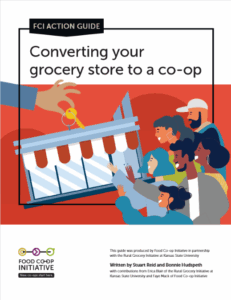
Converting Your Grocery Store to a Co-op

If your community is interested in learning more about how to keep the local grocery store operating in your community, take a look at the Action Guide and accompanying video, as well as this panel discussion with inspiration from three communities that recently transferred operation of their local grocery store to a community-owned co-op. Then reach out to info@fci.coop to learn about next steps.
STARTUP ACCOMPLISHMENTS

Stage 1: The core food co-op organizers in Alpena, MI, (population: 10,197) hosted a successful community meeting with 45 attendees, and walked away with more than 60 interested folks on their mailing list. Organizers with the Annapolis Food Co-op (MD) drafted their business concept using the new NCG DC Business Concept Template from our Framework Collaborative Toolbox!

Stage 3: Fertile Ground Food Co-op (Raleigh, NC) removed a barrier to moving forward with their store location with a major zoning win! On July 7, the Raleigh City Council unanimously approved rezoning the location of the future store to support the co-op. Go Co-op!

Stage 4: West Chester Food Co-op (PA) is in the final days counting down until their store opens. Their team is hired and trained, their POS system is live and tested, they’ve surpassed 800 members, and the final products are arriving and being shelved as we speak. Wish them good luck on opening, and look for FCI’s opening celebration email for all the details!

In other Stage 4 news:

Conversions: Kingdom Co-op in Newport, VT, launched a member-owner campaign as they look to convert privately-owned Green Mountain Natural Foods to community ownership. Theirs is a fascinating history of working to have a consistent source of natural foods in the Northeast Kingdom (as the three northeasternmost counties of Vermont are regally known). The current store traces its origins back to a buying club supported by Plainfield Co-op, landing in Newport in 1977. In the early 80s the store transitioned to private ownership, and after changing hands several times, current owner Rick Woodward, is hoping to have the store return to community ownership.

Store Openings!

Congratulations to the communities that have worked so hard to bring their community-owned store to life:

Coopiversaries

These co-ops are celebrating 1 or more years of being open this month:

Also, a shout out to two Coopiversaries we should have included in our last newsletter. Thanks to Suzette at NFCA for catching these!

Is your food co-op a “3rd wave” food co-op that opened between 1998 and 2024? Did we forget to mention its Coopiversary? Respond to this email so we can add your co-op to our Coopiversary calendar!

2027 PLG Program Applications Open Next Week

FCI Peer Learning Groups logo

The application period for our 2027 Peer Learning Groups (PLG), our most in-demand program, will open Tuesday, September 1.

PLG is a free program that connects food cooperators in similar stages of development to meet monthly to learn, discuss, and build community with their peers.

Every group is facilitated by a co-op development expert, and each monthly learning topic is chosen with group input, based on their unique needs.

Learn more about FCI’s PLG Program.

Watch Now: Summer Tech Series

Last week, we wrapped up the first Future-Ready Co-ops: A Summer Tech Series with the tech and AI roundtable for operational leaders.

Future-Ready Co-ops is a three-part series for cooperators to discuss their needs and challenges with technology for their food co-ops.

Watch the entire series for free on YouTube!

These webinars, which are a continuation of the powerful conversations sparked by our tech-focused FCI Live 2026 sessions, brought food co-op leaders, technologists and practitioners together to explore how co-ops can navigate rapid tech change while staying grounded in cooperative identity.

This series was presented with Ahzjah Simons of DigiCo Global and Rickie Bailey and Johnny Chirse of Nova Works Corporation.

UPCOMING EVENTS & WORKSHOPS

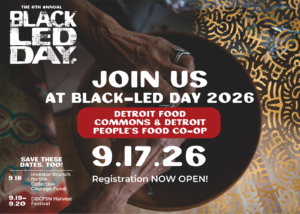
There’s still time to register for Black Led Day 2026 in Detroit, MI

The 6th Annual Black Led Day. Join Us at Black Led Day 2026 at the Detroit Food Commons & Detroit People's Food Co-op. September 17, 2026. Registration NOW OPEN!

Register today for Black Led Day 2026, happening Thursday, September 17 at the Detroit People’s Food Co-op in Detroit, MI.

Black Led Day is a powerful gathering exclusively for Black cooperators, organizers, farmers and food systems workers from across the U.S. to center Black cooperative leadership.

National Black Food and Justice Alliance (NBFJA) and the Detroit People’s Food Co-op are co-hosting this year’s event with the theme: ‘And Still We Rise: Cooperating Toward a Liberated Future.’

Learn more about Black Led Day by visiting the NBFJA website.

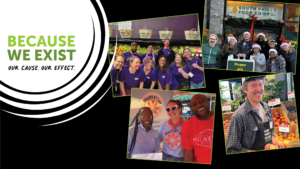
‘Because We Exist: Our Cause, Our Effect’ returns in November

Join us for our year-end tradition where we gather virtually to hear stories directly from open startup food co-ops about how they’ve impacted their communities, staff, vendors, and member-owners. Because We Exist. Our Cause. Our Effect.

Save the dates for Monday, 11/9 through Friday, 11/13.

because we exist promo no date

These sessions will be free to attend and we’ll send an email when registration opens.

In the meantime, get caught up on the stories of South Philly Food Co-op, Market 166 and more.

THANK YOU TO THE FIRST 15 – LET’S GET TO 75!

Thank you to our first 15 Full Circle Co-ops who have donated or pledged to donate in 2026: Assabet Co-op Market, Basics Cooperative Natural Foods, Belfast Food Co-op, Common Ground Food Co-op, Community Food Co-op Bellingham, Dill Pickle Food Co-op, East End Food Co-op, Food Shed Co-op, Friendly City Food Co-op, Lexington Co-op, Moscow Food Co-op, Syracuse Co-op Market, TPSS Food Co-op, Weaver Street Market, and Whole Foods Co-op!

We need your food co-op to donate/pledge and “get on the map” with these 15 co-ops. FCI truly cannot continue building the food co-op movement’s future without you.

In 2025, a record-breaking 60 established food co-ops became FCI Full Circle co-ops by donating to our work, raising a total of $93,000. That’s 17.3% of FCI’s work entirely funded by donations from food co-ops in 2025!

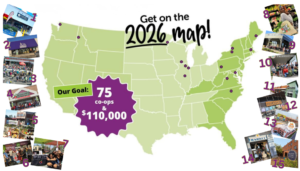
With our federal cooperative development funding under even more threat in 2026 and nonprofit funding shrinking everywhere – we are asking established food co-ops to help us break this record again. Our 2026 goal: 75 Full Circle donor co-op donating a total of $110,000.

Our 2026 goal: 75 Full Circle donor co-op donating a total of $110,000.

2026 full circle map for aug enews

*YOU* CAN REVISION UP & COMING’S FUTURE

Up & Coming, the national gathering for startup grocery co-ops, will return next year in Detroit and we need your voice.

**Take this 10 min survey to shape next year’s Up & Coming Conference!**

The input collected through this process will be collated, studied for patterns of response, and then turned into decisions about the future of the conference by FCI with extensive input from the ReVisioning Team.

The results of this process will be shared back via email with the entire startup grocery community later this fall.

Learn about the different ways you can give your input this fall on the future of Up & Coming.

More about Up & Coming’s future

Why is U&C paused in 2026?

Who is designing this ReVisioning process?

Black Led Day 2026 in Detroit (next month!)